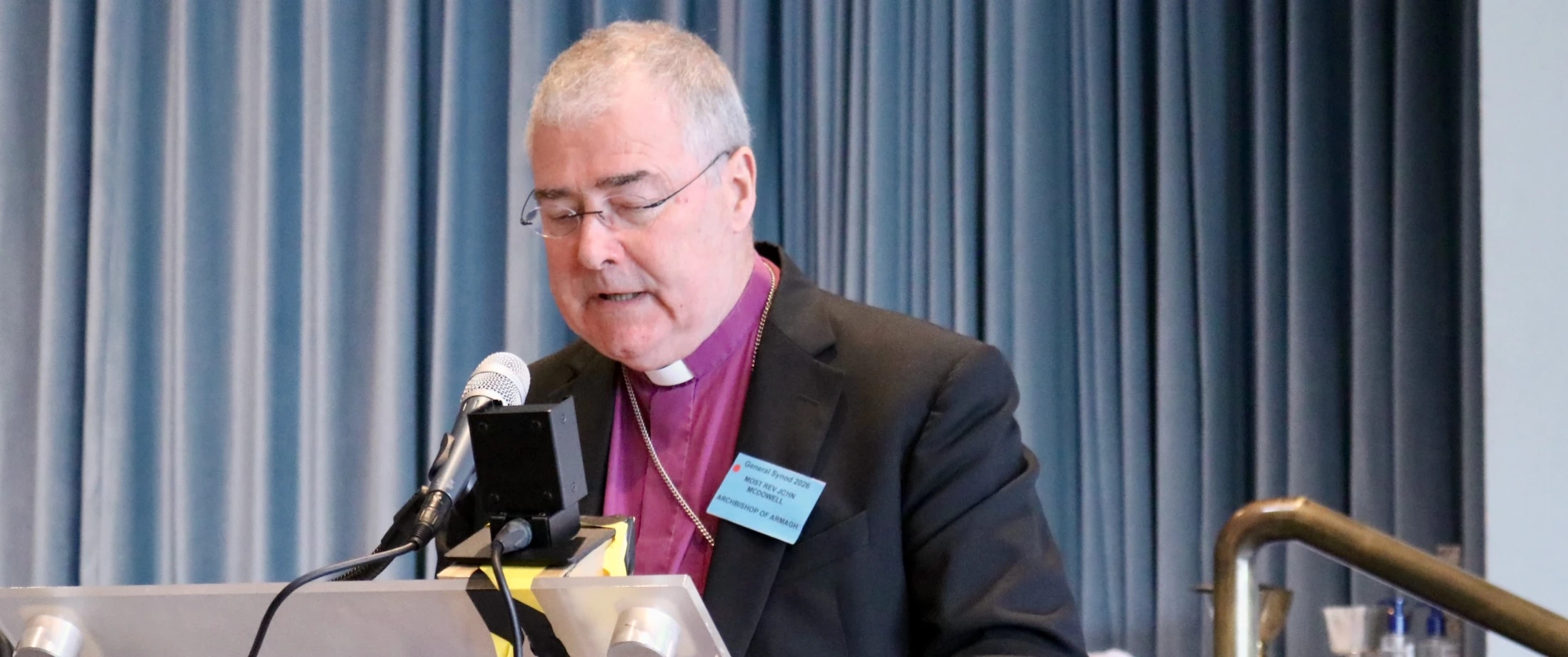
Archbishop McDowell addresses General Synod 2026
Archbishop John McDowell has addressed the Church of Ireland’s General Synod, meeting in the Slieve Donard Hotel, County Down.
The Primate emphasised the parish as the core setting for worship, discipleship, safeguarding, and local mission, while warning that modern digital culture—especially social media and generative AI—can erode truth, deepen dependence, and counterfeit community in ways that the Church must resist.
The Archbishop also highlighted migration as a key test of Christian authenticity, condemning racist violence and urging practical care for “the stranger,” before noting the upcoming Anglican Consultative Council meeting (ACC-19) and offering appreciation for the retiring Bishop of Meath and Kildare.
The full text of the Presidential Address is below or download the PDF HERE.
Brothers and sisters in Christ,
I would like first to thank the Diocese of Down and Dromore for acting as our hosts for this Synod and particularly to thank the bishop and all those who have been involved in planning and preparing for our Synod Eucharist earlier this morning.
I suspect like many people in the General Synod over the years, I have sometimes been a little bit wary of the term “Presidential Address”. The words are, of course, constitutionally accurate. The Archbishop of Armagh is indeed the President of the General Synod and, as a privilege and as a responsibility, I wouldn’t want that to be otherwise. And it’s not even that the word “President” has lost some of its lustre in recent times on the world stage. It is more to do with the fact that my calling, and the calling of any bishop, or indeed priest, is a calling to the work of a shepherd. If you like, it is a vocation of care and of solidarity to be lived out in the manner of the Good Shepherd; I hope it is in that manner that I have addressed the General Synod in the past and will do so today.
So, although I may refer to it from time I do not intend to go into the business - the Bills and Motions - of this Synod in any detail. Each will be handled by very capable members of the General Synod and, as always I will rely on the good sense of the Synod to weigh the arguments and to think of what is best for this Church in its witness to the Gospel of Jesus Christ and in its searching out of the will of the Father. For it is His will and not our own that is to be done. In fact that is the great issue of all life: the life of individuals, the life of churches, the life of communities and the life of nations.
I am, I think, in the unique position of having been the only Archbishop of Armagh to have presided over a General Synod in the season of Advent - the online Covid Synod of 2020 - which, you might say, is the season of accountability. And that is a good reminder of our accountability and to whom we are ultimately accountable for what we do and say - including the way that we do and say it here, where the mountains of Mourne sweep down to the sea.
It is the vocation of the Church of Ireland to witness to Ireland as it is today of the love, the holiness, the goodness and the power of God as revealed in His Son. That has never been an easy vocation. It is not that Ireland is a particularly wicked and resistant place but that the People of God find it as difficult as anyone else to set aside our self interest in the interests of God. In some senses it is even more difficult for us because we easily make the assumption that God is already on our side and thus avoid doing the work - the prayer and reflection - that will make sure that we are on His side.
The structural manner in which we go about this work is fairly straightforward. We do it in parishes. In terms of the Church of Ireland, that is where the work of God is largely carried out. It is where the Scriptures are expounded, where the sacraments of the New Covenant are duly administered, where children are catechised, where believers become disciples, where the sick are visited and cared for, and where the community is evangelised. Although Churches may be severely damaged in the eyes of the world by adverse headlines; they break the heart of the Good Shepherd by falling short in the work of parishes.
It is for these reasons that most of our resources, both centrally and locally, are focused on parish life and why the tab labelled “Parish Resources” opens into the largest section of the Church of Ireland website. It is also why we are so deeply committed to safeguarding in our parishes - making them safe and welcoming places. You will see from the Book of Reports that we continue to review and revise, and we trust improve, our Safeguarding procedures and structures.
In a world which is dominated in almost all its doings by the often sinister ambitions and networks of a very small number of very rich men who are infinitely more powerful than any Celtic chieftain or medieval magnate or elected Chief Minister, we have both the structures and the resources to march to a different beat and to create different societies. The parish is the place that is big enough to require everyone to pull their weight and small enough for that mutual giving and receiving which is at the heart of communion; to be places that stand out in the world and which can change the landscape and the horizon.
That is why it can be very painful, and indeed scandalous, when parishes go badly wrong for whatever reason; and because of the relational nature of our structures, such damage can be very difficult to mend. Although parishes cannot be little earthly paradises, they can be the tiny leaven in the rude lump of a subtly-manipulated world; the parish can be where true wisdom and truth may still be found and true friendship flourish.
Parishes can do much - and in our polity they do most of the heavy lifting - but they cannot do everything, particularly in an age of a very rapid change in attitudes to God and His Church. It is partly for that reason that we have devoted substantial human and financial resources to supporting our vocation and mission with Pioneer Ministry- to reach those who have lost any contact with the promises of God in the Gospel. Parishing and Pioneering go hand in hand and I commend to you the work of the Pioneer Ministry Council, which we shall hear about later.
AI
I have said that it is our vocation as the Church of Ireland to witness to an alternative truth and to march to the different drum beat in a world which has a very wayward set of priorities. It is a world which has become more atomised and angry through the new forms of digital communication and networking. Social media was the phenomenon which was to have democratised the world but instead it has concentrated power in the hands of the few grotesquely rich men I referred to earlier. Its centralising tendencies and amorality are a much more effective means of dividing and conquering than any Roman Emperor had at his disposal.
Currently their great emphasis is on the development of AI which is being heralded as another great leap forward in the liberation of humankind. The truth is, of course, that such ‘liberation’ only binds us further: we are increasingly dependent on technology, especially digital technology, and thus on the electricity necessary to keep it going and on the global corporations extending its reach into every aspect of human life.
I say this is ‘the truth’ on purpose: for we should be confident in the very existence of ‘truth’ and ‘fact’ – neither of these things can be artificially generated. Artificial Intelligence may relay information to us based on incredible calculations of probability and suitability, but we should not allow efficiency and convenience to become the primary values against which we measure whether this information is worth the resources expended to generate it. The costs are human and social as well as environmental, of course.
Writing sixty years ago, the philosopher Hannah Arendt (Truth & Politics, 1967), learning from the experience of totalitarianism in Europe, explained how it is that we might find ourselves becoming comfortable in a so-called ‘post-truth’ world. “Lies”, she wrote, “are often much more plausible, more appealing to reason, than reality, since the liar has the great advantage of knowing beforehand what the audience wishes or expects to hear.”
This is precisely how digital technologies, such as generative AI and social media algorithms, work and appeal to us; they are founded on inordinate masses of data which enables accurate prediction of what it is we wish or expect to hear. Thus, their efficiency can only take us so far – and with enormous risks. For, as Arendt argued, “reality has the disconcerting habit of confronting us with the unexpected, for which we were not prepared.”
How easily we can collectively fall, from complacency into dependence, and thus into extreme vulnerability. The process of AI-integration is all the more dangerous not because it is manipulated by the powerful but because it is increasingly accepted by us as a logical choice. As Arendt warned, what is false can seem more rational than reality.
You would have thought that there were certain things which the Church does that are safely away from the digital world and thus unaffected, such as personal accompaniment of the sick or of those in difficulties. However in a presentation to the Celtic bishops last week in Wales, Mark O’Toole, the Catholic Archbishop of Cardiff-Menervia was able to tell us about the huge number of young people who have “companion bot” apps on their phones. These are AI generated “people” who can be turned to for advice in times of sickness or relationship breakdown or in any crisis. Again, this can seem a rational thing to do in times of weakening social bonds and grossly inadequate support for mental wellbeing, especially for younger people.
However we need to remember that AI Large Language Models do not actually “know”, much less feel, anything or experience empathy. They merely convert data into numbers and, in super fast time, identify patterns within those numbers which will then generate language. But – it hardly needs to be said – what people need in times of crisis and in terms of companionship is more than empty words.
Since the time of St Paul, Christianity has been understood as an individual’s relationship with God, lived out in community. Being “in Christ” through baptism and faith is the believer’s fundamental identity and all other roles - parent, worker, priest, politician etc. - are subordinated to that identity. Rooted in the Trinity, Christian belief and communion is wholly personal and unreproduceable. That said, its message and outcomes can probably be counterfeited or distorted by AI, and I have no doubt that in the near future we will all be offered a very attractive and cheap range of resources to enhance and strategise our efforts at evangelisation.
But we need to remember the most effective of means of all, summed up in one short sentence: “Many were gathered together… and he preached the word to them”.
We have many challenges and opportunities in the future to resist the homogenising of knowledge and the eroding of local autonomy. And the decisions we will need to make will simply make no sense on the grounds of efficiency and convenience: to stick to the difficult path of deep and costly human relationships, sustained by a closeness to God in prayer and in the wearying but essential task of moral discernment.
Migration
Just while we are on the subject of St Paul, there is one other concept which philosophers of thought attribute to him. The Roman world in which St Paul moved was characterised by a sense of radical inequality. It was a strong conviction at that time that the world - individuals, roles in society, gender - were unequal and were meant to be unequal. In the view of the people of the time, that was how the world was made and how it worked best.
Paul was the first thinker to overturn this idea. “There is neither Jew nor Greek, slave nor free, male nor female; for all are one in the Messiah Jesus”. That word “one” signalled a new transparency in human relations. Because of what he understood the Christ to be, Paul insisted on the moral equality of all humans, on a status shared by all and, of course, the possibly of creating a new “self”- everyone who is in Christ is a new creation.
The Church, never mind the world, has never quite learned those lessons about human equality that Paul so assiduously worked out. This is nowhere more painfully clear than in our attitude to racial equality and migration. It is my own view that our attitude to migration in Ireland, both north and south, is one of the great touchstones and tests of our Christian authenticity. It is possible to take a wide range of views on immigration policy which may be broadly consistent with belief in Christ and in the particular form of human equality which is articulated in the New Testament.
But it seems to me that there is a fairly simple imperative when it comes to the “stranger that is in your midst”, and that is to welcome him or her and to care for him or her. It is also time to put a few myths to bed. Migration is not some form of organised conspiracy aimed at the colonial dispossession of the Irish people, as has been claimed by the extreme right in Ireland. Nor is it an attempt at creating a Muslim majority or a Muslim state, as has been called by many on the British extreme right. Migrants to this island are motivated by exactly the same desires which motivated the Irish immigrants to the USA in the eighteenth century - a desire for civic and religious freedom - or which motivated many Irish people to the emigrate to the USA and Britain in the nineteenth century: hunger and destitution.
Migrants to this island want what we all want-to bring up children in security and decency; to provide them with a good education and the chance of a stable future. And to contribute to the communities in which they live. They bring with them enormous energy and fortitude and very often scarce skills. For these and other reasons there is every rational reason to welcome them. Instead what we find as recorded in PSNI statistics in Northern Ireland is, in 2024-25, the worst recorded levels of racist violence since monitoring began in 2004, and an increase of almost 50% on the year before. And in the Republic of Ireland Garda hate crime data show a sustained multi year increase in racially-motivated incidents.
But you and I are called to a much more demanding way of life. To care for the stranger within our midst regardless of ethnic differences is the principal lesson of the parable of the Good Samaritan and defines for us what we mean by the word “neighbour”.
But perhaps the most sobering of all are the words of the Lord Jesus when all the nations of the earth stand before him as Shepherd and Judge “…I was a stranger and you welcomed me…as you have done unto the least of these my brothers and sisters you have done unto me”.
When he ascended to the Father he left his disciples in every generation and with the representatives of his weakness - the sick, the poor, the destitute and the stranger - and the promise that he will gather with his right arm those who have cared for them with the words, “Well done good and faithful servant…” And because they are so terrifying, it is almost unbearable to consider what he will say to those on his left hand “Depart from me…”
That increases in migration should be seized on by the extreme right who are bereft of any other ideas is not surprising, although it is less edifying when mainstream parties equivocate in the face of the horrendous violence which migrants suffer. However from the Churches’ point of view, the more worrying development is the rise of the so called Christian Right. These groups emphasise what they claim to be the undermining of “Christian civilisation” or “Judeao-Christian” values and the discrimination which they say Christians are subjected to. And they use the Cross – the very epitome of powerlessness, and what a very advanced “civilisation” inflicted on Jesus – as some kind of symbol of their dominance and superiority.
The Christian Church, and to a much lesser extent, Christian civilisations have indeed given great deal to the world. The first hospitals, the first schools, heroic women and men who lived with and cared for the world’s outcasts and for the wretched of the earth. Exactly which aspect of discipleship in Jesus Christ is being exercised by baying outside a hostel while terrified children are inside? How is parading around the streets draped in a national flag representing the mind of the God of all the nations, who said: “For my thoughts are not your thoughts and my ways are not our ways… for as the heavens are higher than the earth, so are my ways higher than your ways and my thoughts than your thoughts”.
As I said earlier I have dwelt on these matters because I believe they will be the test of our discipleship and our faithfulness in the days and years to come.
ACC-19 and Unity
As with most General Synods, the Feast of Pentecost is not far off. That was the day when, as St Luke tells us “…they were all gathered together in one place…” Insofar as this is an assembly representative of every diocese of the Church of Ireland and as we are joined by a number of our ecumenical friends with whom we share a common baptism into Christ we might, with a little stretch of the imagination, be said to be altogether in one place. It is an enormous joy and privilege to be here and even greater to have worshipped with you. I am very grateful to the Bishop of Meath to have reminded us of our vocation of unity in her sermon.
However it would be remiss of me not to mention a gathering which we in the Church of Ireland are hosting a little later in the summer, called ACC-19. The Anglican Consultative Council is one of the Four Instruments of Unity of the Anglican Communion. It meets in a Province of the Communion once ever three years and is made up of episcopal, clerical and, uniquely, lay representatives from each of the Provinces of the Communion. As its title-ACC-19- suggests this is its nineteenth meeting and we in the Church of Ireland will be represented by a lay person and a clergy person in the form of Archdeacon Katherine Poulton of the Diocese Meath and Kildare and Mr Glenn Moore of the Diocese of Clogher. I am also a member of ACC, not strictly speaking as a representative of the Church of Ireland but as a member of the Primates Standing Committee and the Standing Committee of the Anglican Communion.
ACC-19 will debate and discuss many issues but probably the most significant will be some suggestions known rather grandly as the Nairobi-Cairo Proposals. These offer a modestly updated description of Anglicanism (the current description hasn’t been revised since the definition offered by the Lambeth Conference of 1930) and also some suggestions around the relationship of Provinces with the Archbishop of Canterbury, together with ways of supporting and assisting the holder of that office in their impossibly diffuse role.
As with all Anglican bodies the ACC Resolutions cannot bind any Province of the Communion and will be sent to all Provinces, including the Church of Ireland for further discussion and any action which a Province may think desirable and edifying.
At the very least I would urge you to keep the members of ACC-19 in your prayers, especially the Chair Canon Maggie Swinson and the Vice Chair Archbishop Hosam Naoun, Primate of Jerusalem and the Middle East.
Bishop of Meath and Kildare
I hesitated for a moment or two before adding theses concluding remarks to this Address as I would not be usual to remark on the retirement of a member of the Synod in either the House of Representatives or the House of Bishops. But as her retirement will come so soon after this meeting of the General Synod, I am going to use the considerable latitude afforded to the President of the Synod to offer the Synod’s best wishes to the Bishop of Meath and Kildare as she prepares for the next stage in her life and discipleship. Pat has been a hardworking and very encouraging episcopal colleague and has enriched the proceedings of the House of Bishops and of the Church in general with her wit and wisdom. It has been a genuine privilege to have known Pat for many years and to have served alongside her. Pat, our heartfelt thanks and good wishes go with you and with Earl for the years to come.
I hope and pray that what I have said provides some sort of context for our gathering here over the next few days . So now let us move onto the real business of the General Synod.
+John Armagh
May 2026