Bishop David sets out seven-year vision for Down and Dromore
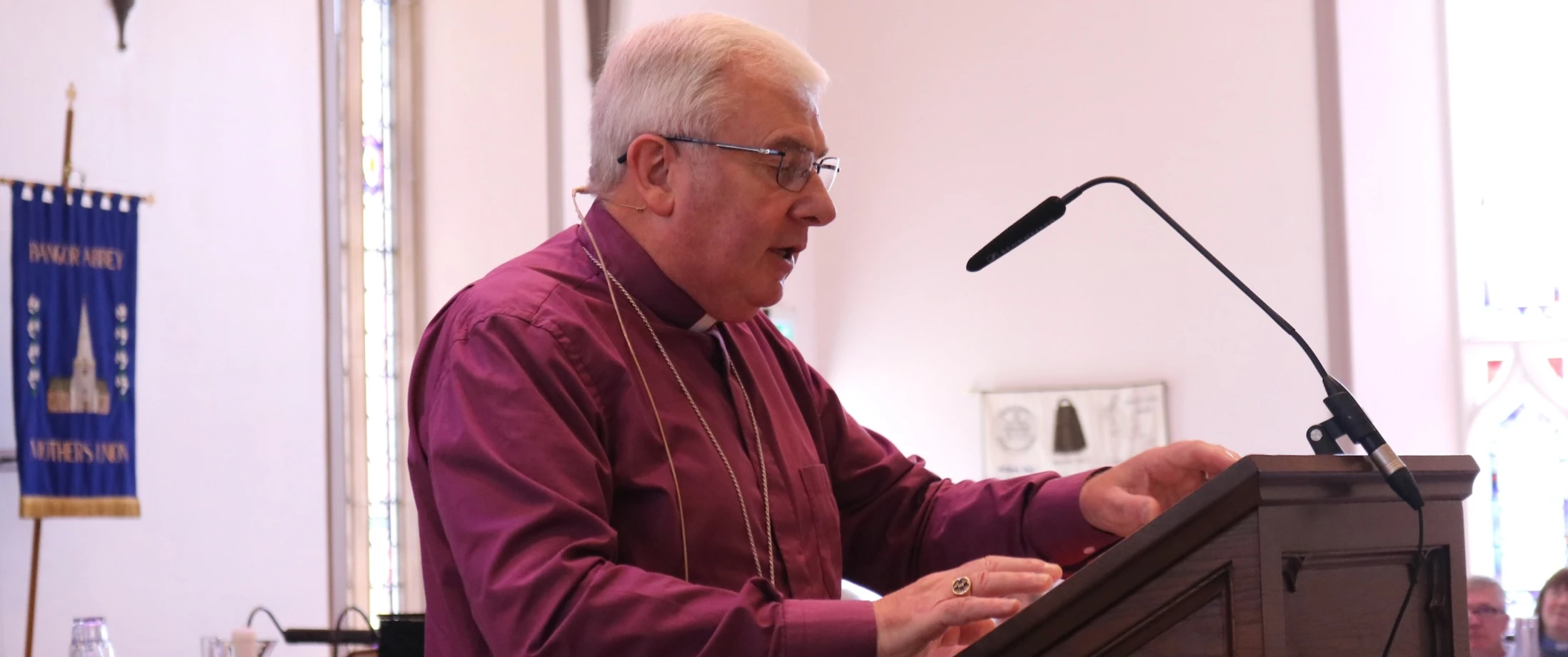
Bishop David McClay used his Presidential Address at Diocesan Synod to set out a seven-year vision for Down and Dromore, urging parishes to receive the past honestly and to hand on “a beautiful legacy of faith in Jesus” to future generations.
Meeting in Bangor Abbey at the beginning of a new three-year synodical term, the bishop said the theme of “Legacy” had been at the forefront of his thoughts. He welcomed members and thanked the parish and rector Canon Ronnie Nesbitt for hosting synod and wished him and his wife Carol every blessing in retirement.
Five years after setting diocesan goals in Discipleship, Leadership and Apostleship, Bishop David reviewed progress and said there were encouraging signs in church planting, evangelism courses, new Bible study groups, Sunday Schools and the training of lay readers, evangelists and future clergy.
The address looked back to the spiritual inheritance of the diocese, from St Patrick’s arrival near Saul in 432 AD to church planting under previous bishops and the evangelistic work of the Decade of Evangelism. Bishop David quoted Archdeacon Mark Harvey’s description of Down and Dromore as standing “on Patrick’s legacy of courageous commitment to the gospel of Jesus Christ” and said the greatest spiritual legacy any generation can receive is “a gospel legacy” that is “biblically faithful, Christ centred, Holy Spirit empowered”.
Bishop David also acknowledged painful parts of the church’s inherited legacy. “The legacy that we inherit will inevitably be a mixture of good, not so good, and some things that are dark and even evil,” he said. These, he added, must be “brought into the light, acknowledged, where appropriate repented of, and dealt with” according to God’s word.
Referring to accounts of historic sexual abuse in Mount Merrion Parish and to a recent BBC Spotlight programme, he said such matters called the church “to humility and repentance for the sins of previous generations”. He said: “Abuse - sexual abuse and physical abuse should never have happened.” The bishop added that he had met, listened to and apologised on behalf of the church to those who had come forward and wished to meet.
At the same time, Bishop David criticised aspects of the broadcast, saying it contained “damaging and misleading inaccuracies” and that its treatment of historic and more recent matters had, in his view, been disrespectful to victims of historic abuse.
He told synod that a live historic claim relating to Mount Merrion remained ongoing and that the programme’s content was being examined legally, so he would not comment further on those issues.
Looking ahead, Bishop David returned to the diocesan priorities of Discipleship, Leadership and Apostleship, saying the diocese must “set our sails for the wind of the Holy Spirit”. He framed the next stage of diocesan life around the practical themes of Scripture, evangelism, growth, prayer, community, mission, children, youth, stewardship and leadership.
The first cord holding the vision together, he said, was the Bible. Marking 500 years since William Tyndale’s New Testament in English, Bishop David urged parishes to make Scripture available to seekers and local communities. He challenged every church to keep Bibles ready to give away and to work with organisations such as the Bible Society to place Bibles and Bible reading plans into every home in their parish.
“Churches built on biblical truth and biblical methods of spreading that truth grow,” he said. Against what he described as decline and revisionism elsewhere, he made a clear pledge: “Not on my watch, and I trust – not on our watch!”
Evangelism was another central theme. Bishop David said real church growth is “always rooted in evangelism and people being saved by Christ forever”. With the 1600th anniversary of St Patrick’s mission to Ireland approaching in 2032, he said the diocese had been entrusted with the same gospel and must place evangelism “at the top of our agenda”.
He urged churches to provide clear pathways for people exploring faith, including Alpha, so that “every man, woman and child” might hear and respond to the good news of Jesus.
On growth, he said attendance could rise significantly by 2033 if parishes continued to deepen their commitment to evangelism, prayer and welcome.
Prayer, he said, must underpin that growth. Healthy churches are marked by evenings of prayer, prayer walking and a confidence that the Holy Spirit is at work. Churches must also love their communities through mercy ministries, welcome for strangers and care for those in need.
The bishop also highlighted the diocese’s global and Ireland-wide mission partnerships. He noted that Down and Dromore parishes had given more than £1 million to mission and outreach and pointed to continuing links with the Diocese of Multan in Pakistan, the Diocese of Santiago in Chile and the Diocese of Maridi in South Sudan, including recent gifts through Fields of Life and support for a new Family Centre in Maridi.
Children, youth and young adults were named as urgent priorities. He said the diocese hoped soon to appoint a new Diocesan Children’s Development Officer and welcomed the appointment of Andrew McClelland as Youth and Young Adults Development Officer. “We will be prioritising providing resources to enable our churches to grow younger,” he said.
Pastoral care, stewardship, digital ministry and the raising up of leaders were also highlighted as important for the next stage of diocesan life. The bishop said pastoral ministry today required the church to “get its hands dirty” and for shepherds to “smell of the sheep”.
Setting out a year-by-year pathway to 2033, Bishop David named 2027 as a year of stewardship, 2028 as a year of creating community, 2029 as a year for children’s ministry, 2030 for youth ministry, 2031 as a Year of Prayer, 2032 as a year when every church would hold a ten-day mission marking Patrick’s anniversary, and 2033 as a Year of Celebration marking 2000 years since Christ’s passion, death, resurrection, ascension and Pentecost.
Concluding, Bishop David said these priorities would not be isolated annual projects but blended commitments shaping the whole diocese over seven years. His hope, he said, was that Down and Dromore would grow “younger, stronger, deeper, numerically” and in its calling to extend God’s rule in lives, parishes and communities. Returning to Colossians 1:28-29, he urged synod to make Paul’s words the touchstone for the years ahead: “He is the one we proclaim… so that we may present everyone fully mature in Christ.”
DOWNLOAD THE FULL TEXT AT THIS LINK (PDF)
Other synod news
The day began with a service of Holy Communion when we were delighted to welcome the Archdeacon of Raphoe, the Ven David Huss as our preacher. Taking the Gospel reading as his text (Matthew 7:21, the wise and foolish builders), Archdeacon David reminded us of the urgent need to build our lives on the foundation of Scripture which means being both hearers and doers of the word.
After lunch the Report of the Diocesan Council was warmly received having been proposed by Mr Billy Fyffe and seconded by the Revd Ali Calvin. A variety of contributors rose to speak on diverse topics, from pioneer ministry to graveyard regulations and climate impact grants to organ scholarships.
Also in the afternoon session synod members heard presentations from Mr Chris Thomson (Tearfund's work in the Middle East), Mr Andrew Brannigan (Church of Ireland Three-Year Census analysis and Safeguarding) Mr Andrew McClelland (our new Diocesan Youth and Young Adults Officer), Mr Mark Wells (the work of Bible Society NI) and Mrs Claire Neill (Diocesan Financial Report).
Motions
Following a short explanatory presentation by Mrs Claire Neill, Mr Mike Johnston proposed two motions of Diocesan Council regarding the Diocesan Assessment:
Motion One
It is proposed that for 2027 the cap on the maximum amount of Parish Assessment that can be asked from a Parish is raised to 10.36% of the Average annual unrestricted income of the three years being assessed.
Motion Two
It is proposed that the total amount of Diocesan Assessment for 2027 be raised by 3.6%.
Both motions were seconded by the Revd Catherine Simpson and passed unanimously by synod.
Thank you
As the meeting closed, Archdeacon Jim Cheshire thanked Bishop David on behalf of synod for his faithful leadership of the diocese in mission and ministry saying, “Through your vision, encouragement, and pastoral care, you have continually called us to lift our eyes beyond present challenges and to look with confidence to what God can do among us.”
Archdeacon Jim acknowledged the impact of this ministry in changed lives across the diocese, and commended Bishop David for his refusal to accept decline as inevitable. He assured both the bishop and Hilary of our continued prayers, especially for rest and renewal over the summer, as the diocese prepared to embrace the seven-year vision set before it.